Living Documentation
When configurations are written as code, they become capable of documenting themselves. This capability makes documentation an automatic byproduct of the configuration itself rather than a separate maintenance burden.
Alternative Representations
Here’s an example visualisation automatically generated from a Typeflows configuration:
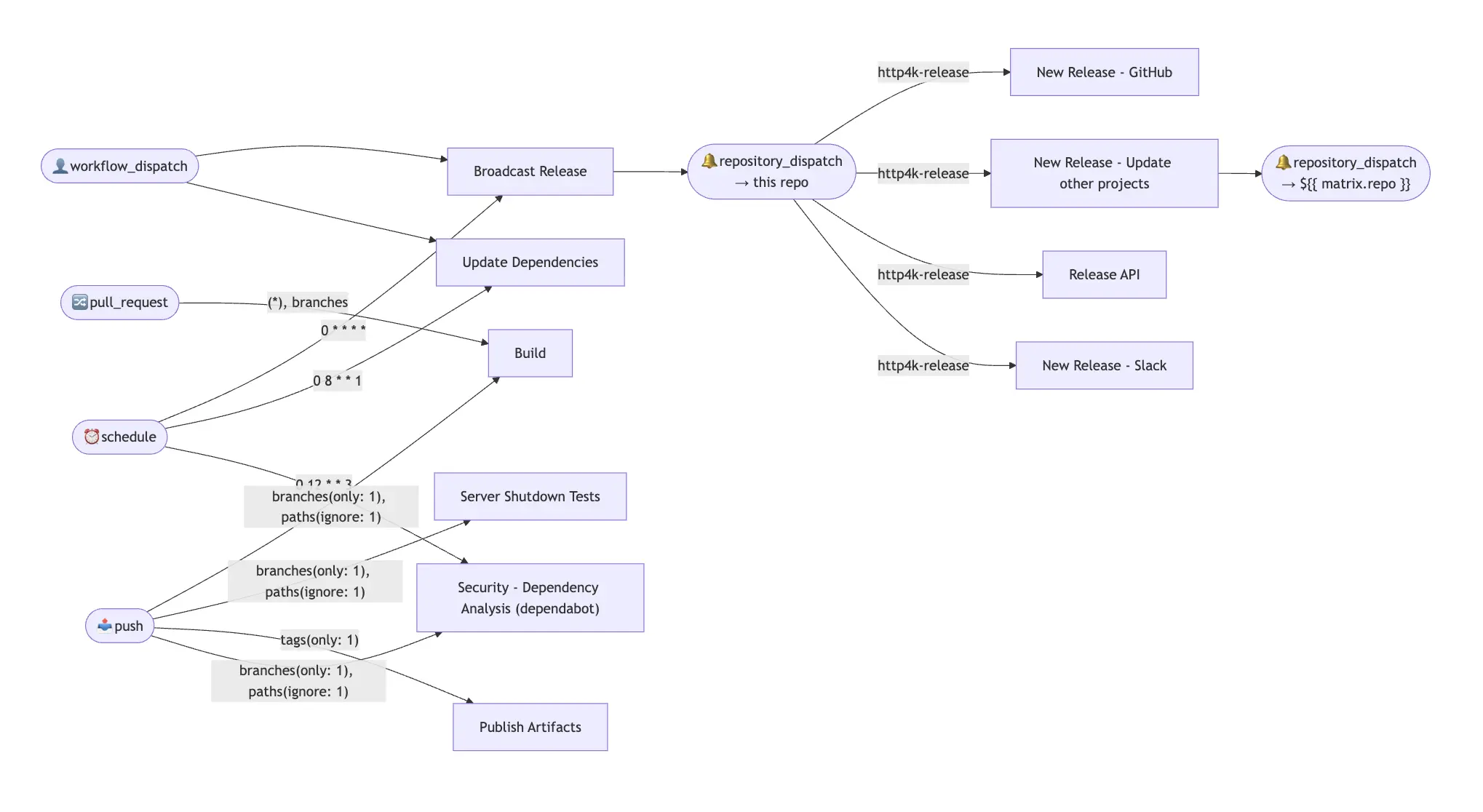
This diagram shows multiple interconnected workflows orchestrated through event propagation - from workflow_dispatch triggers through repository_dispatch events to cross-project notifications. The visualisation reveals the complete release pipeline spanning builds, tests, security analysis, and notifications across multiple repositories, all generated directly from the configuration code.
Beyond visual diagrams, configuration code can generate tables of information, data dictionaries, dependency matrices, configuration inventories, and any other structured documentation format - all automatically synchronised with the actual configuration.
The Problem with Traditional Documentation
Traditional configuration documentation tends to drift - manual documentation can become outdated as configurations change, creating a gap between what systems actually do and what documentation claims they do.
How Typeflows Creates Living Documentation
Typeflows configurations can generate their own visual representations and documentation because the configuration structure contains all the information needed to understand the system. When configuration is code, documentation becomes code too.
Configuration code contains structural information that can be extracted and documented automatically:
System Architecture
The composition and relationships between configuration components naturally express system architecture. Complex hierarchies become visible through generated diagrams that show how components interact and depend on each other.
Flow and Dependencies
Configuration dependencies, execution flows, and logical relationships can be extracted and visualised without manual diagram creation. The code structure itself defines these relationships.
Composition Patterns
How shared packages are consumed and combined becomes visible through generated documentation that shows the configuration ecosystem and reuse patterns.
Key Benefits
Generated visualisations create documentation that:
Stays Synchronised
Because visualisations are generated from the configuration code itself, they automatically reflect any changes. This eliminates documentation drift - the documentation remains an accurate representation of the current system.
Provides Multiple Perspectives
The same configuration can generate different views for different audiences - high-level architectural overviews for stakeholders, detailed dependency graphs for developers, and operational views for systems teams.
Eliminates Maintenance Overhead
Teams no longer spend time maintaining separate documentation. The configuration maintains itself through generated representations.
When configuration is treated as code, documentation becomes just another output format - as reliable and maintainable as the configuration itself.